
A showcase of the breadth and depth of the Harding Distinguished Postgraduate Scholars Programme was on display at the 2025 Welcome Event.
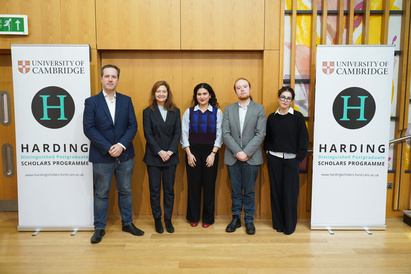
Special guests gathered at St Catharine’s College, including the Vice-Chancellor Professor Deborah Prentice, Pro-Vice-Chancellor for Education and Environmental Sustainability Professor Bhaskar Vira, Master of St Catharine’s College Sir John Benger, and James Holmes, Executive Director of the David and Claudia Harding Foundation, to welcome the 2025 cohort to the University of Cambridge, and for a special panel discussion.
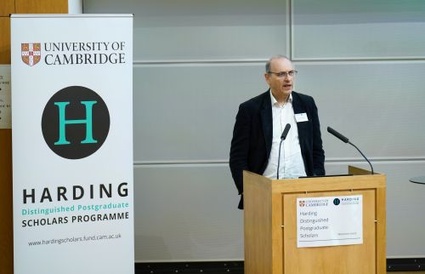
It is always a demonstration of the range of subjects being studied on the Programme, and this year was no different as the topics featured clinical medicine, English and music.
“The Harding Welcome Event is extremely important for building strong ties across the interdisciplinary community, allowing me to learn about topics that I otherwise may not have known about,” said James Shonhard, who is part of the 2024 cohort and was one of the students on the panel.
“This event opened conversations about our research up after the talks where I learnt about the different topics people were covering in their studies.
“As a result of the interactions fostered during the Harding events, I have met people in different departments and fields who may be useful for my research in future.”
James’ research investigates the involvement of inflammation in multiple brain diseases, namely Parkinson's Disease, and the atypical Parkinsonian disorders Progressive Supranuclear Palsy and Corticobasal Degeneration.
He added: “I have always been interested in neuroscience from a young age due to my brother having a neurological condition, eventually leading me down the path to studying for a PhD in Clinical Neurosciences.”
James was joined on the panel by Shadi Seifouri, who is part of the 2022 cohort, and felt that the Welcome Event was a great opportunity to learn about the work of colleagues in other fields.
Shadi is a musicologist and cultural historian researching 19th-century opera and its material histories, with the doctoral research proposing a new object-led history of 19th-centry opera, arguing for stage props as overlooked interlocutors of the European canon.
She said: “Seeing how research often manifests from such personal points of departure (i.e James’ wonderful work on Parkinson's and PSP from his experience with a brother with Cerebral Palsy) through to Frankie’s work who honed in on such a wonderfully novel area of poetry (lawnmowers), research is a reminder of how our work reflects something about ourselves. In short, research does not exist in a vacuum: it is a composite of interconnectivity, conversation, and most importantly community.
“The Welcome Event encourages cross-disciplinary dialogue in the broadest sense. The divide between the humanities and the arts is one of the most difficult systemic challenges in academia, which is why events like this are important reminders that these are industries more similar than they are different.”
The third member of the panel was Frankie Gardner, part of the 2022 cohort, who is working on an English PhD with a thesis on pastoral singing contests in the 18th-century.
“I was drawn to the pastoral because I am interested in nature poetry, especially when the idea of the natural is probed at – when it comes into contact with the city, for example, or with technology (the latter has led me to lawnmower poetry, another of my research interests),” she explains.
“It was wonderful to hear the other Harding Scholars present on their work – our areas of research are all so diverse!
“It’s also a fun challenge to present on your research to people outside of your field. And, of course, having the chance to meet scholars from the incoming cohort.”
She added: “I met one of the Harding Scholars from the 2025 cohort, Rose Gibbs, who is in the Department of Sociology working on Alevi-Kurdish urban gardens, and we had a wonderful time exploring how our research interests intersected. This kind of encounter is what makes the Harding Welcome Event really special.”
Article by: Mark Taylor, Donor Communications Associate, University of Cambridge Development and Alumni Relations
Images by: Chris Loades