
Dr Edwin de Jager
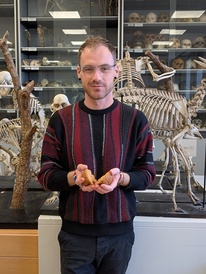
Dr Edwin de Jager
South Africa
Archaeology, Lucy Cavendish College
PhD thesis: How did the Human Brain Evolve? Tracking Cerebral Changes in the Fossil Hominin Record Using Advanced Imaging Techniques and 3D Modelling
My research investigated how the hominin brain evolved over the past 3.7 million years by analysing cranial endocasts from 58 fossil specimens spanning Australopithecus, Paranthropus, and Homo. Using high-resolution scanning and automated detection methods, I developed a reproducible protocol to map cortical sulcal imprints, minimising subjective interpretation. The study revealed four distinct morphotypes reflecting key evolutionary shifts in frontal and occipital lobe organisation, demonstrating a mosaic pattern rather than a single trajectory. Regional differences emerged, with southern African hominins showing earlier occipital reorganisation than eastern African populations. This work bridges palaeontology, neuroanatomy, and digital imaging, providing a replicable framework for studying brain evolution. This research resulted in peer-reviewed publications, including work in Human Brain Mapping and contributions to the Australopithecus africanus centenary volume, with manuscripts under review at Science and Journal of Anatomy.
After the PhD
Following completion of my PhD in Biological Anthropology at Cambridge, I secured a two-year Fyssen Foundation postdoctoral fellowship at CNRS/PALEVOPRIM in Poitiers, France. My current research continues to advance paleoneurology through computational approaches, building on the automated detection methods and imaging protocols developed during my doctorate.
I am working on publishing findings from my thesis while developing new collaborative projects, including analysis of the Sahelanthropus tchadensis endocast, one of the earliest known hominins at approximately 7 million years old. This work extends the taxon-free, population-based analytical framework to broader questions in brain evolution. I am also exploring enhanced imaging methodologies and refining density-based approaches to sulcal pattern analysis. My research maintains focus on developing reproducible, user-independent protocols that integrate neuroscience-based approaches with palaeontological evidence to advance our understanding of cognitive evolution in early hominins.